Author: Niels Hexspoor

CALL – Aurora Lecture Series ‘Environment and Care: Canadian Perspectives’

Our Aurora partners at the Canadian Studies Centre of the University of Innsbruck, together with Universität Duisburg-Essen invite you to participate in an innovative transatlantic teaching project. 

The Aurora Lecture Series ‘Environment and Care: Canadian Perspectives’ is looking for a diverse range of lectures on the Canadian perspective on Environment and Care from various disciplines, combining the Aurora Pilot Domains of Culture: Diversity & Identity and Sustainability & Climate Change and the Sustainable Development Goals.

If you are interested, send in your proposals for research-led teaching units (à 90 minutes) now!  including an abstract of 250 words at most which make reference to the following:

Please also indicate when (see “Sketch and rough time table” below) the contribution could be made.

The proposals should be forwarded to the Canadian Studies Centre of the University of Innsbruck (canada.centre@uibk.ac.at) by September 10, 2021.


The full pdf-version of the call can be found here.


Sketch and rough time table

Working title of the course

Environment and Care: Canadian Perspectives

Type of course unit

Optional (Interdisciplinary Competences)

Level of course

Bachelor (EQF 6)

Prerequisites (for students)

none

Referring Pilot Domain

Culture: Diversity & Identity

Sustainability & Climate Change

Referring SDG(s)

4, 5, 10, 11, 13, 16

Year of study

2021/2022

Semester of delivery

Summer Semester 2022

Number of ECTS credits allocated 

3 credits

Type of course

Lecture series (Ringvorlesung)

Course director


Other speakers/contributers 

Doris G. Eibl & Ursula Moser (University of Innsbruck)

Barbara Buchenau & Florian Freitag (University Duisburg-Essen)

tbc

Learning outcomes of the course:

Students can demonstrate a deeper insight into an environment and care sensitive understanding of Canada. They have become acquainted with exemplary research areas and are able to classify these in terms of the Sustainable Development Goals. Besides, this course aims at developing all forms of critical thinking, in particular with regard to the following competencies: System Thinking Competency, Anticipatory Competency, Collaboration Competency and Integrated Problem Solving Competency.


Course content:

The course, which is intended as an introduction to Canadian Studies, aims to present and discuss a number of recent developments in Canada through the lens of Environment and Care, which we see as key concepts for a future-oriented and sustainable understanding of different facets of the country. While the term “environment” refers not only to air, water, and land in or on which people or animals and plants exist, but also to circumstances, objects or conditions by which people or animals and plants are surrounded, the term “care” implies “everything we do to maintain, continue, and repair our ‘world’ so we can live in it as well as possible. That world includes our bodies, ourselves, and our environment, all of which we seek to interweave in a complex, life-sustaining way.” (Tronto/Fisher 1990, 40)

Along the focal points

·         Histories and Politics

·         Indigenous Contexts

·         Intersectional Issues

·         Literatures and Media

·         Mountain and Glacier Studies

·         Multiculturalism and Federalism

·         Urban Visions and Realities


Mode of delivery

Online

Suitability for short term mobility

no (lecture series)

Planned topics

The course is planned as a lecture series from week 17 to 25 (an overview concerning the academic calendars can be found under Question 17 in the FAQ of Aurora Office Innsbruck):

Assessment


Knowledge query based on questions concerning the single sessions

Passed (>60%) / failed (tbd)

Language of instruction

English

Registration procedure for non institutional Aurora-students and

See landing page Aurora Innsbruck

number of places available

No limitation

Criteria for the allocation of places (e.g. “first come first served”)

Not applicable
(no limitation of participants)

Recognition

Students are asked to clarify the creditability of this course for their studies before registering! At Universität Innsbruck, the course is to be offered as a curricular course within the framework of Interdisciplinary Competences (elective module).

Aurora Student Champions and Ambassadors Celebratory Event – Looking Back

As you know the Aurora Student Champions and Ambassadors Scheme has finished for 2020/2021 and we are already looking forward to welcoming returning and new Champions and Ambassadors for the next academic year.

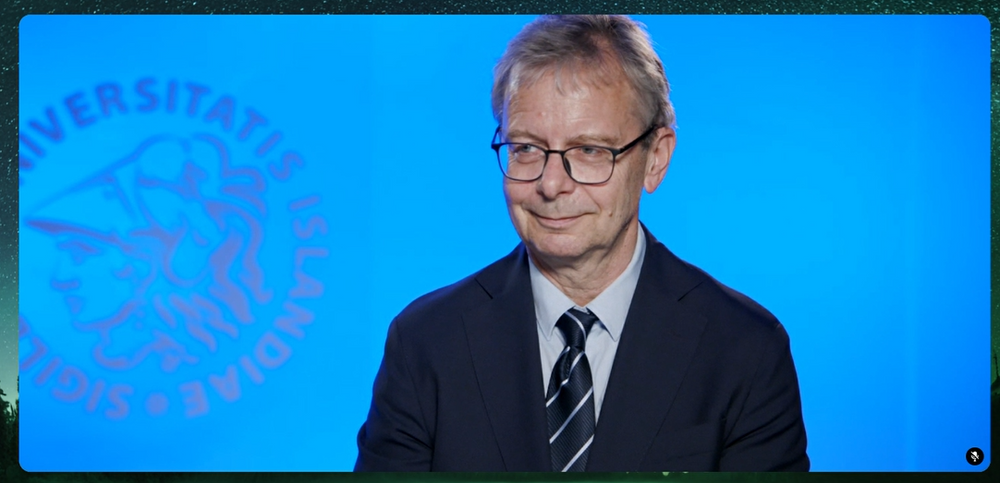
A celebratory event was held on the evening of 16 June and was well attended by Aurora Students, Aurora Staff and the Aurora and University of Iceland President, Jon Atli Benediktsson. 

A number of Champions and Ambassadors, shared personal reflections of their Aurora journey representing their own Universities on areas of importance to the Network and Alliance.

For those of you that were unable to attend please view the recording of the evenings event https://ueanorwich-my.sharepoint.com/:v:/g/personal/k827_uea_ac_uk/EWBj5moeZ-JJmUEAm37myHQBgVBvtRxwfVK9B6xCyK7Yhg?e=BJK9TY

CALL – Aurora Alliance Joint Courses on Sustainable Development Goals

If you are an academic enthusiastic about teaching on SDGs from the perspective of your discipline, or a current research theme relating to one or more SDGs, this is a call for you!

Join our academic community in the making of fellow academics passionate about the SDG perspective. by expressing your interest to teach together with colleagues from other Aurora Alliance universities. 

The make SDGs more prominent in the teaching offer of the Aurora Alliance, we aim to organize a series of joint lectures and a joint introductory course on Sustainable Development Goals. The latter, taught fully online, will already start the upcoming Fall semester.

If you would like to be involved in this community and help set the teaching standards and develop these curricula, we invite you to contact Miroslav Syrovátka (miroslav.syrovatka@upol.cz), currently collecting this information as UP representative concerned with Aurora’s SDG-offer. 

In your email, make sure to include:

  • The title of one or more proposed lectures
  • Short one-paragraph outline(s) explaining to which SDG (one or more) it relates  

 The lectures are intended for master level students and we invite non-technical, introductory, and interdisciplinary contents.

If you are keen and ready to teach from an SDG please make sure to contact Mr. Syrovátka. We will be open to receive your general expressions of interest throughout April and May.

We are very pleased to already announce latest list of Palacký University Aurora SDG-Lectures.  This list will be updated as more lecturers join our Aurora SDG-teaching community!   

CALL – Martí i Franquès programme Doctoral Contracts at the University of Rovira i Virgili


On the 1st of July, our partners at at the Univerity of Rovira i Virgili (URV), opened the call for applications for each one of the three editions of their Martí i Franquès programme: standard, with 28 contracts; COFUND, with 20, and Banco Santander, with 13. The deadline for applications is 6 September 2021.

The Martí i Franquès is a programme of URV grants that aims to increase the University’s human resources in the field of research. At the same time, it reinforces doctoral programmes, doctoral theses and the training of doctoral students on research and innovation projects. This Thursday is the first day for applications for 61 contracts of three different editions; the standard (28), COFUND (20) and Banco Santander (13). The successful applicants will be employed for up to three years. The call provides contracts in all fields of research at the URV. Applications can be made online until 6 September 2021.

Standard edition

Candidates for the standard edition can opt for a 1-year contract, extendable to 3 years, for doing a doctoral thesis as a member of a research group on one of the doctoral programmes taught at the University. The successful candidates are obliged to submit a doctoral thesis at the University but they will also be given the opportunity to do some teaching. Likewise, they will be able to take part in training programmes for specific purposes and general competencies, and they will have access to high-quality research infrastructure in a highly international environment. One of the 28 contracts on offer has been funded by the Fundació I2Cat (Internet and Digital Innovation in Catalonia). The successful candidates will be able to start work at the University as from December 2021.

Banco Santander edition

For the first time on the Martí i Franquès programme, this call for applications has a new type of edition thanks to the renewal of the collaboration agreement between the URV and the Banco Santander. This agreement has an effect on a variety of areas and can be divided into three main parts: education, employability and entrepreneurship. Education is a strategic aim and the 13 predoctoral contracts in this area have funding of €880,000. Thanks to the sensitivity and the commitment of this financial institution to the recruitment of talent and training, the funding of the Martí i Franquès programme has increased significantly.

COFUND edition

The Martí i Franquès COFUND project is co-financed by the European Union as part of the COFUND Doctoral Programme of Marie Sklodowska-Curie Actions (MSCA) in Horizon 2020. The 20 contracts that were still pending, one of which is reserved for a disabled person, are now being announced. The aim is to attract highly talented research staff from all over the world and give them the chance to have a research career at the URV. The contracts that will be signed by the successful candidates, aligned with the MSCA contract standards, substantially improve the contract conditions in terms of salaries and the availability of funds for research expenses. Among other eligibility criteria, the candidates cannot have resided for more than 12 months in the previous 3 years in Spain. That is to say, the aim is to locate international students with a master’s degree or equivalent or Spanish researchers who have been away and wish to return. A committee made up of URV staff and external evaluators will assess the candidates’ training, research results, professional experience, motivation and references.

The Tarragona Provincial Council (Diputació de Tarragona) supports the activity of the URV, including the Martí i Franquès Programme.

For further information: https://www.urv.cat/en/research/support/programmes/marti-franques/


Excellent Science in Horizon Europe – The Marie Skłodowska-Curie Postdoctoral Fellowships

The Marie Skłodowska-Curie Actions (MSCA), part of Horizon Europe, and the European Union’s flagship funding programme for doctoral education and postdoctoral training of researchers, organizes many different actions and funding opportunities. Our Aurora partners at the University of Duisburg-Essen offer an information event and in which you will receive hands-on advice on how to write a successful MSCA fellowship application.

What to expect:

Monday: 12.07.21, 10:00 – 11:30 a.m.
• Presentation of facilities and services at the UDE, which are helpful during the application process but also after a successful project application (Science Support Centre, Graduate Centre Plus, International Office).

Tuesday: 13.07.21, 10:00 – 11:30 a.m.
• Information on the Marie Sklodowska-Curie Postdoctoral Fellowships by a speaker of the EU Cooperation Office of the German Science Organisations (KoWi)

Thursday: 15.07.21, 10:00 – 12:00 (limited number of participants!)
• Field report of a successful applicant and exercises for successful proposal writing by a speaker of KoWi
In order to enable an individual and most fitting consultation, the exercises on Proposal Writing on 15.07.21 are only available to a limited number of participants. Early feedback on your participation is therefore recommended. The other parts of the event are open to all interested parties.


Please register via the following link:
https://eveeno.com/2021_ude_msca_postdoctoral-fellowships 

Click here for the full programme (pdf).

Co-Creation Courses

Aurora and its universities offer a variety of different co-creation courses, open to students from all Aurora Partners. Consider enrolling, for example in the “Tools for Enterpreneurship” course at the University of Rovira i Virgilli, a course on International Service Learning at VU Amsterdam, or Project management in Social Work Practice at Palacky University Olomouc.

At the moment, a total of nine courses are available. For a full overview of the courses, the terms and the registration deadlines please take a look at this table

Looking back at the Aurora Biannual of May 20-22

On May 20 – 21st, the tenth Aurora Biannual took place, where Aurora presidents, students and staff met to learn from and with each other.

The first day began with an opening plenary focusing on the future of academic collaboration between British and other European universities following Brexit. Ms Adrienn Kiraly, Head of the Cabinet to Mariya Gabriel, European Commissioner for Innovation, Research, Education, Culture and Youth, touched upon our collaborations with universities and said “Your alliance is already well placed to be a role model for other higher education institutions in Europe and beyond: Your association with three other higher education institutions in Bulgaria, Slovakia and North Macedonia as well as your commitment to developing a capacity development support programme for more than 30 Universities from Central Eastern Europe and neighbouring countries testify for this.” She also highlighted our collaborations with our students by saying: “I am very happy to see that you have put in place the Aurora Student Champions Scheme in order to ensure student representation in each of your activities.”

During the plenary, Paul Boyle (Vice-Chancellor Swansea University and EUA Vice-President) outlined the 7 key points UK universities must address in order to advance in academic collaborations. One of these points is the need for a European wide funding system open to the world. He mentions that universities in the UK feel fortunate to be part of Horizon EU and participate in the vast majority of that scheme. However, there are many other countries from which they could gain value collaborating too. Karine Samuel (Vice President for International Affairs of Université Grenoble Alpes) stressed the importance of international collaboration and how the Aurora collaboration was especially useful in the pandemic by exchanging experiences and best practices with other Aurora universities. Ms Emily Reise from the University of Iceland added a students’ voice and emphasized on the accessibility and mobility of students and sees the advantage of short term mobility experiences for students.

After lively parallel session presentations and dynamic conversations, we entered the virtual reception building where Jón Atli Benediktsson (Aurora Network President and Rector of University of Iceland) welcomed the Minister of Education, Science and Culture of Iceland, Lilja Alfredsdottir. Ms Alfredsdottir believes that the strength of Iceland lies in its international collaborations and that these collaborating networks have ensured that Icelandic research is truly global and ambitious. She says: “No single institution can tackle world challenges on its own but collaboration brings a strength that can be greater than the sum of its parts. With that in mind, the European Commission has focused its recent efforts in higher education on forming strong European University networks capable of producing internationally competent European students, European research, and European solutions”. Jón Atli introduced Ms Anne-May Janssen who will take over from Kees Kouwenaar as Secretary-General of Aurora from July 25th of this year. The reception also welcomed a comedy sketch by comedian Ari Eldjarn. Ari enthused the public with his charismatic interpretations of the many European cultures.

The second day continued with open parallel dissemination sessions and a wrap up of the reports and reflections. President of the Alliance Board Mirjam van Praag shared the accomplishments and challenges of the last 6 months. Among the achievements are the many courses that have been identified to be Aurorarized, a 2-year master program, an international traineeship program, a framework for mobility grant allocation, the 32 students engaged in the Aurora Student Champion Scheme and 15 student ambassadors. Next to accomplishments, Ms van Praag also shared a key concern about the involvement of academics in Aurora and integrating Aurorarized course into existing degree programs. A full overview of the achievements can be found here.


In total, 25 of Aurora’s active working groups and task teams met during the Biannual, and dissemination sessions informed a wider Aurora audience on aspects of the Aurora programme of activities.

In the wrap-up, it was announced that it is the last term of Callum Perry, initiator of the Aurora Student Champions Scheme and that his successor will be elected in the following months. And lastly, Maria José Figueras Salvat, Rector of Universitat Rovira i Virgili, announced that the fall biannual 2021 will physically be organized in Tarragona.

Health & Wellbeing Summer Meeting

On the 28th of June, the Health and Wellbeing Pilot Domain is organizing a summer meeting with a duo purpose to show education and research activities in the Health and Wellbeing pilot domain. The aim is to pave the way for the birth of a Health and wellbeing community within Aurora, with collaborations among the AURORA partners in the field of Education and Research. Therefore, the focus of the meeting is to present the activities in the field of Health and Wellbeing and to exchange ideas on current and future activities.

Programme

10.00 – 10.05 am Welcome and Introduction

10.05-10.20 am  Presentation of a map of the Health and Wellbeing education within the Aurora universities

10.20 -11.00 am Education Session

Participants (one or two for each university) presents the teaching activities within the Health and wellbeing domain. Each presenter should provide information on:

    • Initiatives opened or to be opened to all aurora students
    • Existing, planned or even ideas for new activities in collaboration with other Aurora partners

11.00-11.15 am  Discussion

11.15-12.00 am Research Session

Each university presents their research interests by answering the following questions

    • what are the main areas of research of my University
    • Research infrastructures that could be shared among Aurora Universities (WP 4.2)
    • How being part of the Aurora Network could bring benefits to your research activities

Participants can register at the following link

Aurora Service Learning Toolbox

On June 17th, the Aurora Service Learning Toolbox will be launched during the international learning lab conference, and will take place from 15:30 to 18:00 CEST.

The toolbox will provide relevant tools and resources to interested teachers and students interested in learing more about Service Learning.

These tools will further strengthen existing Service Learning courses and give the teachers inspiration on transforming an existing course by adding a service learning perspective. The event is open for students, teachers and experts from the Aurora universities and other national/international guest Universities for a broader discourse on service learning.

The event will include talks from international Service Learning experts:

  • Prof. Robert Bringle (Professor Emeritus, Indiana University – Purdue University Indianapolis, USA),
  • Prof. Wolfgang Stark (Professor Emeritus, Universität Duisburg Essen, Germany),
  • Prof. Marjolein Zweekhorst (Professor, Athena Institute, VU Amsterdam).

The event will also include presentations of students from Interdisciplinary Service Learning (iCSL2) – an “Aurorised” course open to Master students from any discipline/program across Aurora universities.

Click here for more information and access to the zoom meeting ID and password.

More information regarding the Aurora Service Learning Toolbox will be added soon. 

Aurora Alliance Newletter #02

The Aurora Alliance has released its second newsletter in May 2021. Take a look at the newsletter for a comprehensive update on the latest developments in the Aurora Alliance, discussing for example the latest updates from across Aurora, the summer courses on offer across the alliance, and upcoming events such as the Aurora Spring Biannual.

Next to that, the newsletter contains interesting blogs, columns, and profiles, created by the active and engaged Aurora Community.

You can read the newsletter here.

Want to stay updated, and be among the first to read about the latest Aurora developments? Why not subscribe to the newsletter!

Aurora Biannual: May 20th – May 21st

It is time again for the Aurora Biannual! This community-building event, taking place twice a year, is the ideal opportunity to connect with Aurora colleagues from different universities.

Spread over the entire day of Thursday, May 20th and Friday, May 21st until Mid-afternoon, academics, students, university leaders and administrators will come together to continue ongoing work, meet new colleagues and celebrate existing friendships.

Register here

The Aurora Spring 2021 Biannual commences with a plenary session featuring European Commissioner Mariya Gabriel (in a recorded address) and a panel discussion on the future of academic collaboration between British and other European universities following Brexit. Prof. Paul Boyle, the vice-chancellor of Swansea University, UK and EUA Vice-President, will discuss this and join a panel discussion with Prof. Yassine Lakhnech (president of the University of Grenoble Alpes, member of Aurora) and an Aurora student representative (TBC). The panel will be moderated by John Style, Vice-Rector International of the University of Rovira i Virgili.

The first full day on May 20th will end with a lively and informal virtual reception. Jón Atli Benediktsson will be introducing the incoming Aurora Secretary-General.

In between Plenary and Reception, the first Biannual day will offer many active Aurora task teams the time to sit and work together in parallel time slots in the morning and early afternoon. Simultaneously, the Aurora presidents will discuss their vision of Aurora’s future and the future benefits of being an Aurora university.

The afternoon will also feature four broad parallel sessions, each covering one of the more overarching themes of Aurora, such as “Education”, “Stakeholders”, “Academic engagement”, and “Sustainability”. Aurora welcomes president Joan Gabel of the University of Minnesota as a guest of honour. President Gabel will take part in the “Sustainability” session and share her views on the topic.

On Friday, May 21st, both the Aurora Universities Network and the Aurora European University Alliance will have a session of their respective supreme governance bodies: the Network General Council and the Alliance Board of Presidents. These formal meetings will be part of the first and second Friday parallel timeslots. The Aurora Network, General Council meeting, will run concurrently with many dissemination sessions in which Aurora Biannual participants can find out about tools and services being developed to help Aurora academics, students and administrators. The Aurora Alliance Board of President’s meeting will run simultaneously with more task team working sessions.

For more information on the biannual, please take a look at the programme below:  

Programme Aurora Biannual Spring 2021

Aurora COVID Student Conference – 14:00-17:00 BST, 7th May 2021

The University of East Anglia (UEA) are delighted to be hosting the second Aurora COVID Student Conference on 7th May from 14:00-17:00 (BST). This is a free virtual conference for students from across all Aurora Universities to hear from, and engage with, experts working at Aurora partner institutions who have been active in responding to and researching the ongoing COVID-19 pandemic. Confirmed speakers are Prof Helena Gillespie and Prof Yoon Loke (UEA), Ingibjörg Magnúsdóttir and Anna Bára Unnarsdóttir (University of Iceland), with Dr. Kelly Edmunds and Prof Neil Ward (UEA) also available for questions.

This conference should be of particular interest to students who are interested in infectious diseases or who are considering a project or dissertation related to COVID-19.  The conference will close with a discussion of the key themes that emerge during the plenary sessions. To register your interest in joining this free conference, please email Maria.Fox@uea.ac.uk before 13:00 May 7th 2021.


Conference schedule


14:00 BST

Opening Remarks

Prof Neil Ward (UEA, Norwich)

14:10

Counting the harm from COVID – an inexact science

Prof Yoon Loke (UEA)

14:50

The Icelandic COVID-19 National Resilience Cohort – preliminary results for students.

Ingibjörg Magnúsdóttir and Anna Bára Unnarsdóttir (University of Iceland)

15:30

Break

15:45

Internationalisation and Study Abroad After Covid

Prof Helena Gillespie (UEA)

16:25

Conference Discussion / Questions from attendees

Chaired Prof Neil Ward

17:00

Conference Close


Forthem Alliance – Webinar: Shaping a Fairer World with Sustainable Development Goals

The FORTHEM Alliance, is one of the 42 European University Alliances, and like Aurora, places an emphasis on the SDGs. The FORTHEM Students are organizing the webinar Shaping a Fairer World with Sustainable Development Goals: Gender Equality (SDG 5) and Decent Work and Economic Growth (SDG 8)  FORTHEM student civic engagement project is inviting your students and staff to the discussion about sustainable economic growth, gender equality and decent work addressing the 2030 Agenda for Sustainable Development. Students from the Aurora Alliance are very welcome to participate.  

Webinar: Shaping a Fairer World with Sustainable Development Goals: Gender Equality (SDG 5) and Decent Work and Economic Growth (SDG 8) organised by the FORTHEM Student Civic Engagement Project “Understanding Agenda 2030 – Only one decade left”

Topic: The webinar concentrates on the balance between economic growth and sustainability, as well as the need of reaching gender equality in the world. The webinar is a part of the webinar series “Understanding Agenda 2030 – Only one decade left”.

Date: April 27th, 17:00 (CEST) | 18:00 (UTC +3).

Registration: jyufi.zoom.us 

The webinar is free of charge, available for everyone and organized in Zoom. 

Organiser: FORTHEM Student Civic Engagement Project “Understanding Agenda 2030 – Only one decade left” initiated by UN Association of Jyväskylä, Estudiantes por la FdE Ética and ESN Palermo – Erasmus Student Network.

Find more information about the project and the event on Facebook, Instagram or Twitter.

The project is a part of the FORTHEM Societal involvement initiative supporting student teams in implementing volunteering and education projects for development, solidarity and awareness in collaboration with NGOs or other local and regional associations. Find more about the initiative and FORTHEM here.


2021 Spring School on Transferable Skills

Are you interested in developing your professional skills? This may, our Aurora partners at the University of Naples Federico II offer a free online course, focused on developing skills in grant and CV writing, and how to get a faculty position. This program is open to all Master’s and Ph.d. students from within the Aurora Alliance, particularly those in a STEM-field (Science, Technology, Engineering, Mathemathics).  

The course will give an overview of the breadth of interviews that can be expected on your interview journey and will provide a space to practice interview questions. We will discuss team management and gender equality in academia and research and how improv games may improve your work-life. 

This two-day Spring School will take place on Tuesday the 4th and Wednesday the 5th of May. Participation in this course will allow you to earn 2 ECTS-credits. For more information, please take a look at the Spring School’s website, or the flyer, containing the full program:

2021 Spring School on Transferable Skills Flyer 

Interested in signing up? Please contact internationalfarmacia@unina.it, before May 1st. 

Aurora Mini-Grants – List of awarded Mini-Grants

Friday, April 16, 2021 | After a very successful first call for applications, in which 27 applications were filed, the Aurora Central Office at Palacky University has finished its evaluation. It is our pleasure to announce the applications that will be awarded a Mini-Grant. 

Out of the 27 applications, eighteen project applications were chosen to receive funding. In total, more than 1,6 Million Czech Crowns have been awarded in this first round. The funding of these projects paid directly from the Rectorate’s sources, will serve to further strengthen the Aurora Alliance, and will directly benefit these projects set up by our Academics.

This pilot phase of UP Aurora Mini-Grants received a wide range of applications, spanning several different fields, from five of our faculties and research centers. Below please find the list of funded projects: 


Primary Investigator

Project Title

Barbora SITTOVÁ

Webinars on German grammar

David LIVINGSTONE

Promoting Mental Health among Students with Online Cultural Entertainment

Elona KRASNIQI

Evidencing online risks of youth’s mental health of those coming from state care, and foster care.

Filip KRAUS

Academic Networking on Researching Migration, Identities, and Sexualities in the Vietnamese Diaspora

František KRATOCHVÍL

Wordnets for low-resource languages: Creating a roadmap for using NLP technology to aid language documentation, description, and maintenance

Jaroslava KUBÁTOVÁ

Sustainable Social Enterprises

Lenka DZUROVÁ

Protein engineering in the collaboration with appropriate Aurora Partner Universities

Ľudmila LACKOVÁ

 Aurorization of the course Complex Analysis of Text and Communication Process

Lukáš ZÁMEČNÍK HADWIGER

Theory of Digital Humanities

Martin SOUKUP

Colonialism in 21st Century

Michal PEPRNÍK

Sharing expertise in English studies: Ph.D. workshops and international conference

Miroslav KOPECKÝ

Active aging – a healthy lifestyle

Pavel ZAHRÁDKA

Remix Culture in the Music Industry

Pavlína FLAJŠAROVÁ

Aurora-Shared Interdisciplinary Series of Lectures on Cultural Diversity

Peter TAVEL

Starting shot

Petra VACULÍKOVÁ

Cradle for Excellence in Social Sciences and Humanities (CROSS)

Silvie VÁLKOVÁ

Bringing Academic Writing courses in English up-to-date

Tereza MOTALOVÁ

Galileo for Open Science: Network of Stewards and Navigation Interface for the World of Open Science (“OS Galileo”)

Ordered alphabetically, based on the first name of the PI.

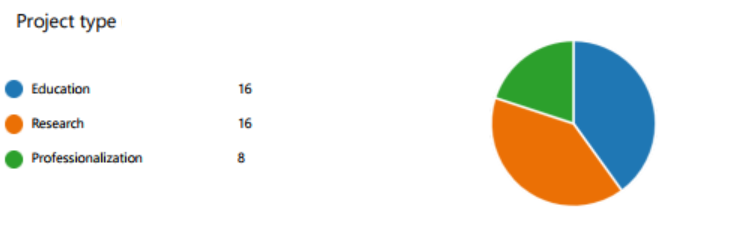
The applicants were asked to specify whether their project dealt with Education, Research, and/or Professionalization, with most proposals concentrating on either Education or research. 

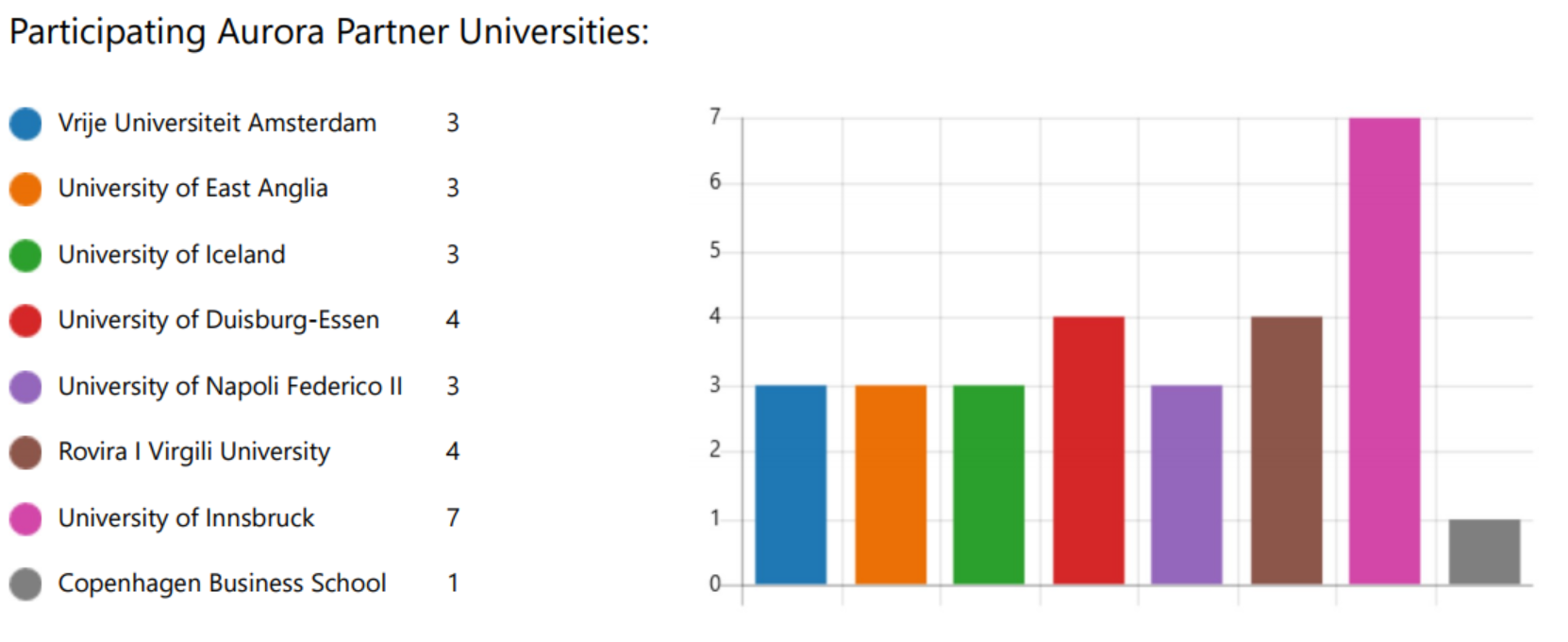
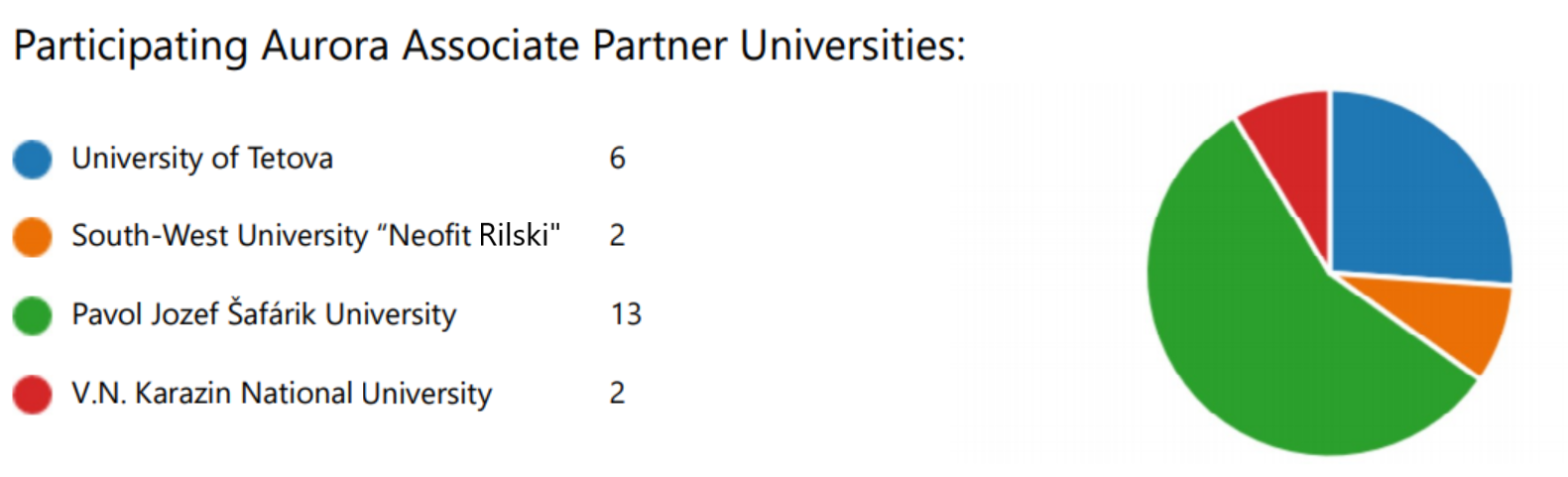
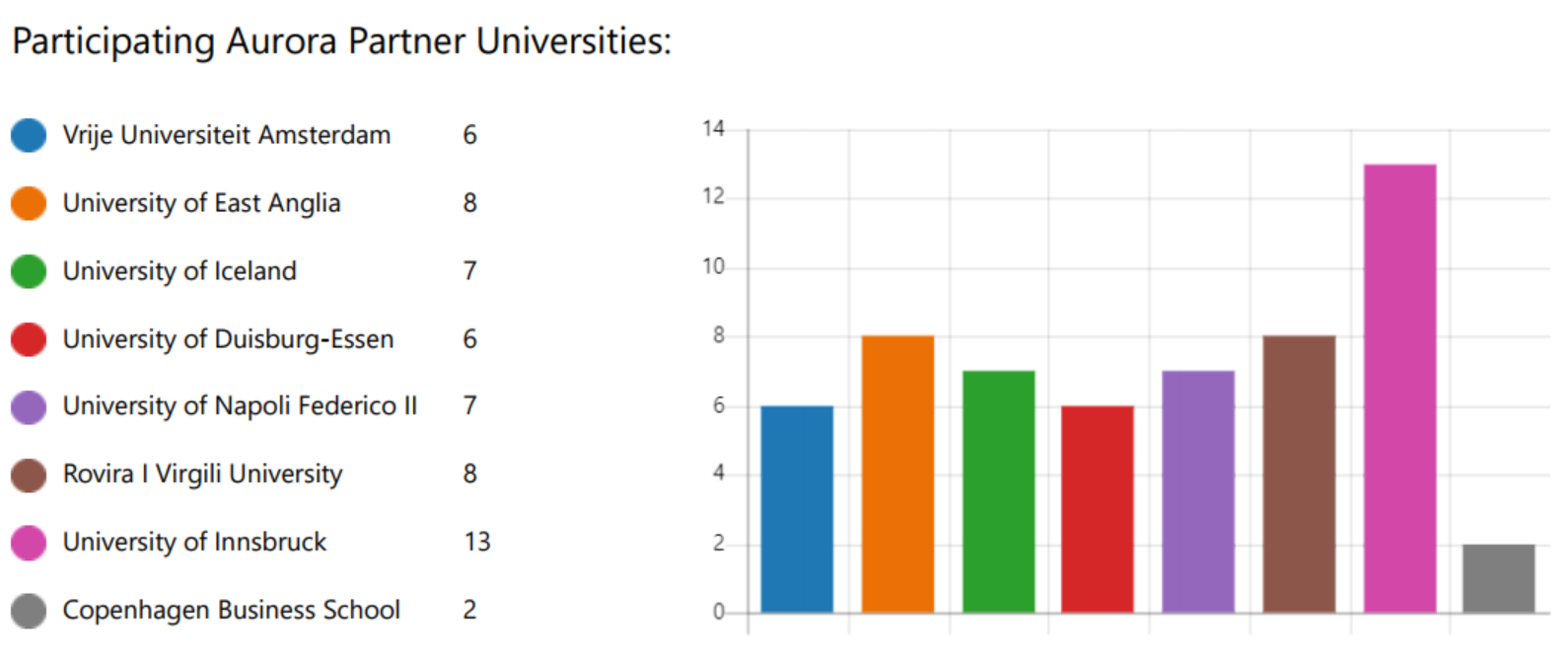
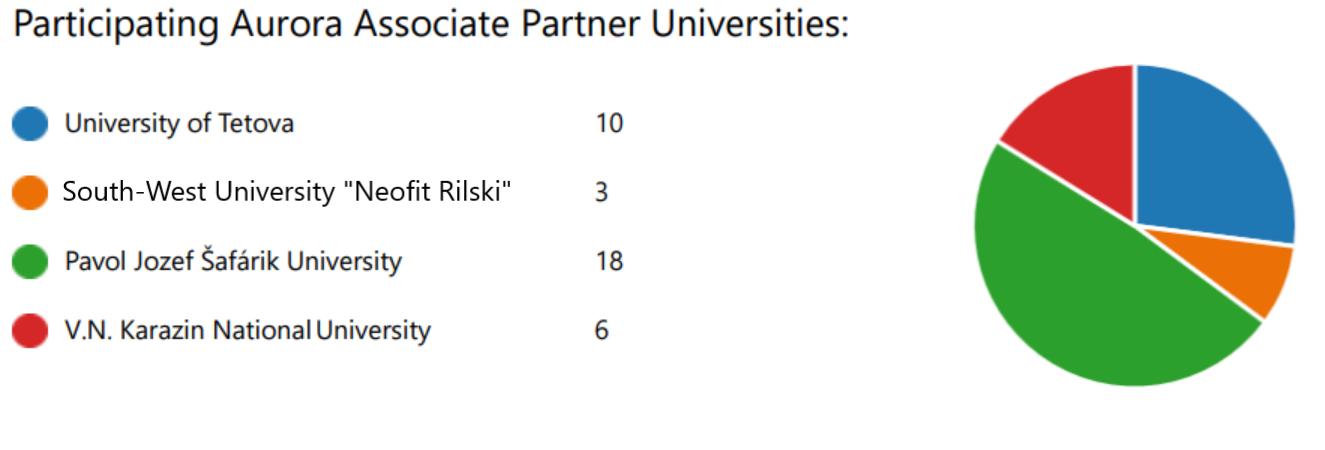
The applicants were also asked to disclose the partner and associate partners named and included in the proposal. The University of Innsbruck and our associate partners from Kosice proved to be the most frequent collaborators.

Partner Universities – Click to Enlarge
Associate Partners – Click to Enlarge

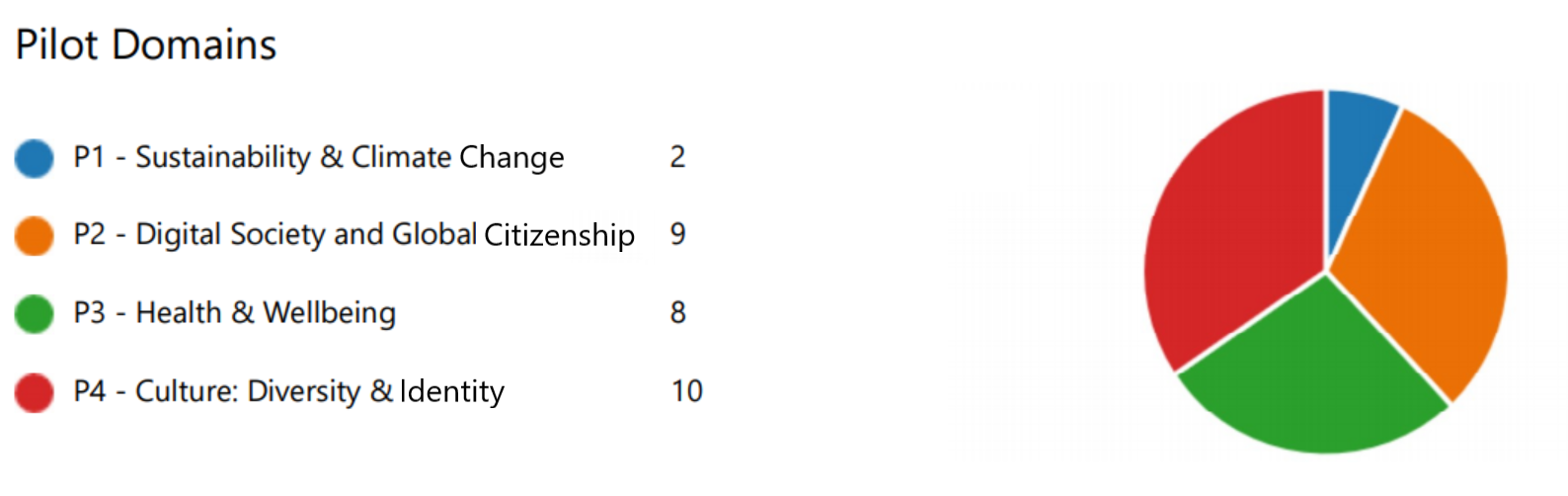
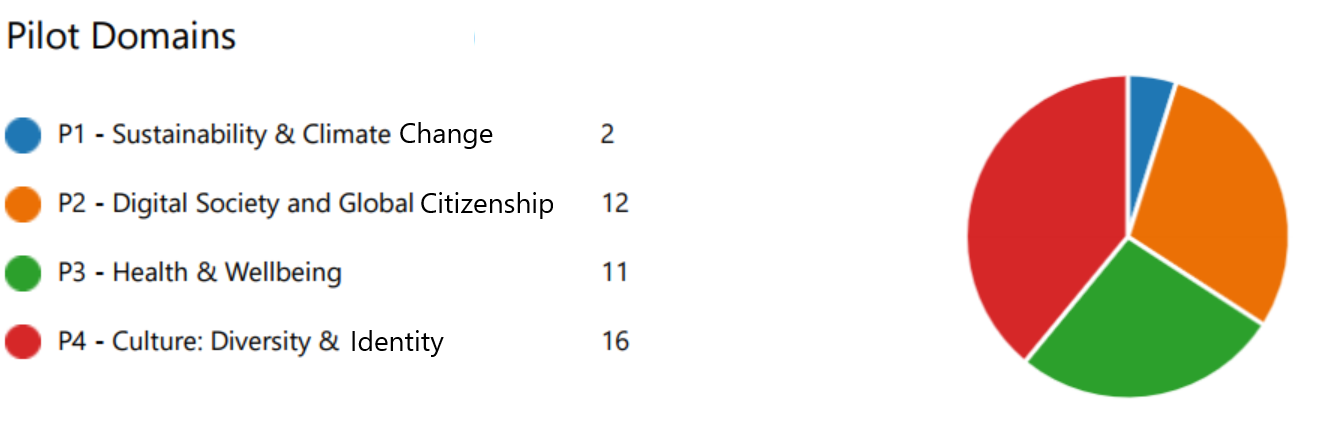
In line with the overall vision and aims of the Aurora Alliance, applicants were asked to tie their proposals to one or several Aurora Pilot Domains. 

Pilot Domains – Click to Enlarge

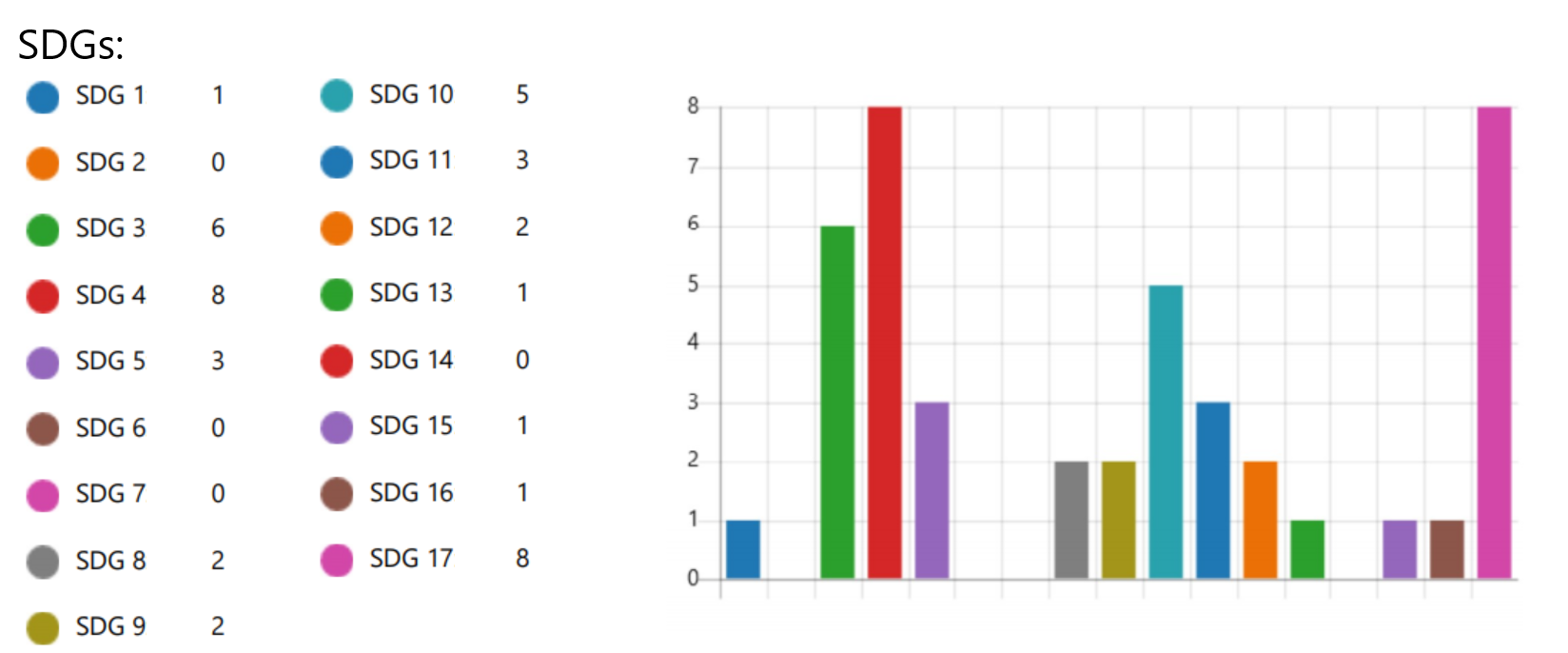
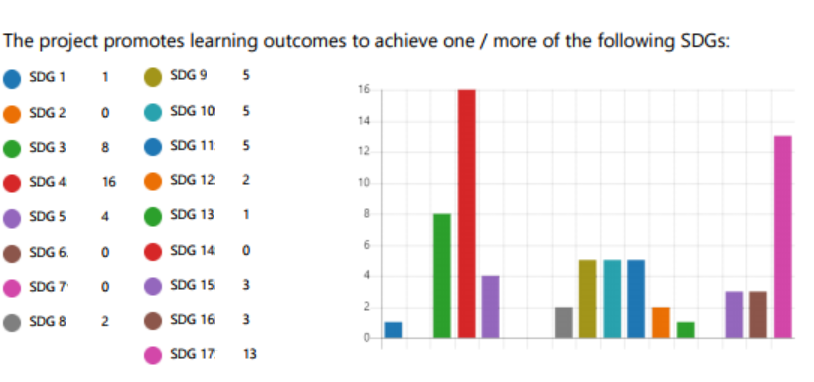
The Sustainable Development Goals also hold an important position in all of Aurora’s endeavors. The applicants were asked to pick at least one of the SDGs and demonstrate how their proposal contributes to that goal. SDG 4: Quality Education and SGD 17: Partnership for the Goals were chosen most often, with SDG 3: Good Health and Well-Being proving popular as well.

SDGs – Click to Enlarge

The UP Aurora Office looks back on a promising, successful pilot phase for its Mini-Grant scheme. We are looking forward to further developing the scheme for future calls, and above all, we look forward to seeing these Mini-Grants contribute to the excellent international projects our Academics will carry out! 

A complete overview of the programs and the participating Academics can be found here: List of Funded UP Aurora minigrants (pdf).

Join an Aurora Short Program or Summer School

Ready to make the most of your summer? Want to study in another part of Europe?

Learn a new skill, develop new knowledge to enhance your degree studies and graduate prospects?

All Aurora university students have the benefit of learning what’s on offer this summer at other Aurora universities, through this one-stop-shop of your Aurora options this summer*. From Global Health to International Criminal Justice and from Central Europe and European Integration to Global Transitional Sociology, there’s a range of subjects to suit everyone, and in many cases, special discounts are provided for students from other Aurora universities.

So what are you waiting for?

Click the button below to access the summer school courses, find out more, check dates and deadlines, and find out how to apply.

Would you like to be kept updated with Aurora university’s short courses and summer schools and associated funding opportunities? Please register your interest by completing this short form. You can also use the form to ask questions that we can direct to the appropriate Aurora university.

We hope you will be able to take the opportunity to study abroad at another Aurora university during your degree!

*Please note that some dates are to be confirmed and delivery modes may change due to unforeseen circumstances. Please get in touch directly with the hosting university for final details.

Report on Aurora Mini-Grant Scheme

Tuesday, April 13, 2021 | After a very successful first call for applications, in which 27 applications were filed, the Aurora Central Office at Palacky University has finished its evaluation.

The project applications and project evaluations are currently being reviewed by the Vice-Deans for internationalization, at their request, with the final outcomes expected by the end of this week. The selected projects are to be funded by the Palacky University Rectorate. 

This pilot phase of UP Aurora Mini-Grants received a wide range of applications, spanning several different fields, from five of our faculties.

The applicants were asked to specify whether their project dealt with Education, Research, and/or Professionalization, with most proposals concentrating on either Education or research. 

Click to enlarge

The applicants were also asked to disclose the partner and associate partners named and included in the proposal. The University of Innsbruck and our associate partners from Kosice proved to be the most frequent collaborators.

Click to enlarge
Click to enlarge

In line with the overall vision and aims of the Aurora Alliance, applicants were asked to tie their proposals to one or several Aurora Pilot Domains. 


Click to enlarge

The Sustainable Development Goals also hold an important position in all of Aurora’s endeavors. The applicants were asked to pick at least one of the SDGs and demonstrate how their proposal contributes to that goal. SDG 4: Quality Education and SGD 17: Partnership for the Goals were chosen most often, with SDG 3: Good Health and Well-Being proving popular as well.

Click to enlarge

The UP Aurora Office looks back on a promising, successful pilot phase for its Mini-Grant scheme. We are looking forward to further developing the scheme for future calls, and above all, we look forward to seeing these Mini-Grants contribute to the excellent international projects our Academics will carry out! 

Looking back on the first CDS Awareness Raising Meeting Webinar

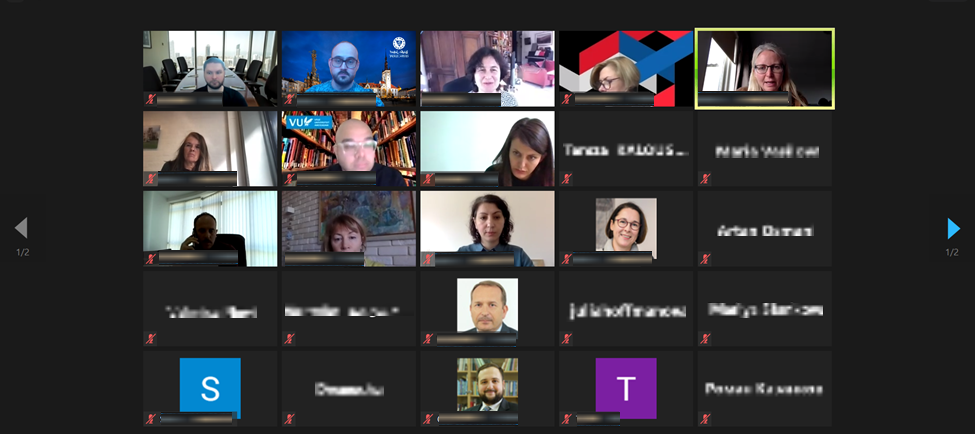
On Friday the 26th of March, the Aurora Alliance organized its first Capacity Development Support (CDS) Awareness Raising Webinar. This meeting, the first of series of six, focused on “Transforming teaching through soft skills, social engagement, and virtual exchange competencies”. As such, it tied into a wide range of Aurora Alliance activities, covering all of the Alliance’s three substantive work packages.

The webinar was organized by Aurora CDS Task Team leader & co-leader – Palacky University and Vrije Universiteit Amsterdam. The sessions were moderated by Selma Porobic (Chair, UP), Anna Bon (co-chair VU), Tereza Kalouskova (co-chair, UP).

„One of the most informative webinars that I have attended lately. It allowed me to see how many opportunities the alliance offers and how many professionals are actively involved in this initiative. Your enthusiasm, creative ideas, and motivation were visible from the first moment. I am happy to be part of your team!“

Mgr. Mária Vasiľová PhD., Pavol Jozef Šafárik University

The webinar gathered our associate partner universities and Alliance members, to take part and discuss three important Aurora deliverables in our joint collaboration: Competence Framework, Service Learning & Co-creation, and VirtualExchange, aiming to initiate the co-creation process with our associate partners.

Kees Kouwenaar (the Secretary-General for the Aurora Universities Network) came to the VU in 2008 as Director for the Centre for International Cooperation and has also managed the VU’s Strategic Internationalisation Programme. Since 2015, Kouwenaar played a key role and is now coordinating the Aurora Universities.

His presentation focused on two distinct examples of competencies from the EntreComp Framework and the VALUE Rubrics framework to highlight how these “soft skills” added to the subject-related knowledge and skills of the course may advance the employability and recognisability of the students/graduates and offer pathways to international peer learning among academic teachers.

“The participation of the UT as an associate partner in such a network, alongside leading universities in research and innovation, presents an excellent opportunity to follow the pace of dynamic developments in the academic world.”

University of Tetova

Marjolein Zweekhorst is professor of innovation and education at Vrije Universiteit Amsterdam. Her research aims to provide insight into themes related to inter- and transdisciplinary research and is focused on the development of educational approaches and innovations in health and life science education and methodology development for interactive policy and interactive technology development in the field of (international) public health (aiming to improve access to health care especially in low- and middle-income countries.

Sarju Sing Rai is a postdoctoral lecturer for Masters program courses – Research Methods, Epidemiology, Global Health, and a researcher in the field of health and societal sciences – community service learning (CSL), global health (GH), and public health (PH).

Their presentation introduced Service Learning and Co-creation as concepts and discussed how these are being developed within their Aurora Alliance task team to support staff and students and equip them with the knowledge, skills, and mindset to tackle societal challenges as social entrepreneurs and innovators.

Barbara Tasser is head of International Services at the University of Innsbruck. Since 2004, Tasser has been in charge of the Italy Centre, and the past five years now of the university’s International Services. Before dedicating herself to intercultural relations, she dived into the history of humankind. In 1992, Tasser began her archaeology studies at the University of Innsbruck.

In her presentation about Virtual Mobility, Dr. Tasser introduced and clarified the concept of virtual exchange and introduced the developing model of the Aurora task team Borderless Learning that she is leading.

Thanks to all! The 1 CDS meeting was most inspiring and productive in terms of understanding of the concept of the deliverables. It is always a pleasure to meet professionals and learn more! The information about the CDS Awareness Raising Meeting webinar will be posted on V.N.Karazin Kharkiv National University site.

Olena Mashintsova, V. N. Karazin Kharkiv National University

The webinar proved to be an excellent starting point for further discussion on the Competence Framework, Service Learning & Co-creation, and Virtual Exchange, as the morning presentations cumulated in a fruitful brainstorming session and discussion, looking ahead to the implementation of these concepts across the Aurora CDS network. 

The 1st CDS Awareness Raising Meeting Webinar put important accents on three modern and envisaging deliverables: Competence Framework, Service Learning & Co-Creation, and Virtual Mobility. The seminar was engaging, interactive, educational, and very productive. New ideas and opportunities for internationalization at home were born. The brainstorming process was really moving. Definitely looking forward to attending the 2nd Meeting! Thank you for your eagerness and inspiration!

Stanislav Grozdanov, South-West University “Neofit Rilski”

Continuing the conversation started during this webinar, the next CDS meeting will take place in the second part of the year.

The presentations, outcomes, and full recording of the session are available upon request, please contact Tereza Kalouskova if you are interested in any of these materials.

Rector Jaroslav Miller: Membership in the Aurora Alliance could be UP’s ticket on the bullet train

How should universities strengthen their position and positive influence on the public space to help our society facing rapid changes with various challenges? By close cooperation on the international level and transforming the results of their research into practice. This is why UP has become a member of the Aurora Alliance. Together with its eight university partners from the Netherlands, Great Britain, Denmark, Germany, Austria, Iceland, Spain, and Italy, in the years to come UP and the Aurora Alliance will focus on the most pressing contemporary issues, such as societal responsibility, sustainable development, climate change, and digitalisation.

Why is the Aurora Alliance so important for Palacký University? What does our prestigious membership in the Alliance bring to the university? What possibilities and challenges will membership involve? How will students, academics, and other employees benefit from Aurora in their personal and professional growth? And how does it tie in with the future success of universities? Rector Jaroslav Miller answers these questions – and much more – in this interview.

Palacký University has been significantly “opened up to the world” under your tutelage and has begun to deepen its internationalisation. Regarding this important strategic partnership under the auspices of the European Commission, what are UP’s visions and plans? Primarily, how will the European Universities contribute to UP’s development?

If we refrain from reducing that question solely to one of financial benefits, then of course by its very nature the European Commission already supports international cooperation and interconnections in all forms and areas. The strategic partnership of universities trough the European Universities programme in my opinion is important in at least two aspects. Primarily, it helps all partners towards achieving qualitative growth; and secondly, it allows them to take part in truly grand consortia projects which will resolve a number of contemporary challenges in higher education. Digitalisation, sustainable development, top interdisciplinary research – these are all areas that transcend one institution and the confines of national borders.

The EC trough the Education, Audiovisual and Culture Executive Agency also supports the Aurora European Universites Alliance of which UP has now become an official part. Aurora has the reputation of one of the the most important internatonal undertakings of UP since 1989. What do you think is ground-breaking about our membership in Aurora?

Our membership in the international Aurora Alliance has the potential to structurally transform Palacký University and make it much more competitive in comparison to the best European and world universities – in other words, it can lead to the highest qualitative phase of development in the modern history of UP. But, of course, that depends on us: whether we take advantage of this historic chance to transform, and whether we have the motivation to become better and aim higher. This is truly a chance without precedent because the European Commission has already demonstrated that it wants to give long-term support to the existing European University alliances. That means that if we will have the determination to work on ourselves, metaphorically we are buying a transfer ticket from the local train to the bullet train. My job has been to open the doors: we either get on board, or they will slam shut in our face, to our detriment.

The historian in me adds that Palacký University Olomouc, with respect to its ambitions and a history longer than 450 years, simply should not be content with the role of a “national university”, which in my opinion is an oxymoron. Quite the reverse, it must transcend the narrow confines of the Czech Republic and strive for a more prominent position – among the academies of Europe and the whole world. I’m firmly convinced that resting on our laurels due to the fact that we are a prestigious university within the Czech Republic is delusive, and actually causes harm to UP.

Which benefits will the Aurora Alliance bring to our university, and what can we contribute with from our end? Which opportunities will Aurora open up for our employees and students?

Personally, I’m in favour of the idea of “symbiotic growth”, which can bring significant, mutual synergistic effects. I’m referring to connecting study programmes and curricula between the individual university members in Aurora, and eventual harmonisation of the systems of quality and evaluation, a shared policy of sustainability, a much higher extent of academic and student mobility than we are accustomed to at present, the use of a shared study and research infrastructure, and joint participation in grand consortia projects. By the way, we are already successful in this area, because as part of the Alliance we were granted a large Horizon 2020, so called  SWAFs project for strategic research development  just last week. And I am sure that this is only the first of many. If we talk about specifics, in the future I can easily imagine, for example, a student studying their field in Olomouc, Amsterdam, and Innsbruck, and then getting a shared degree from these three universities or from the Alliance as a whole.

I’ll mention one area in which UP plays an absolutely key role within Aurora. Our university was entrusted with the coordination of partner relationships with associated universities from Eastern and Southeast Europe. This is an important part of the entire project and Olomouc has been given great leeway within it, as well as great responsibility.

Will the Aurora Alliance have a positive impact on student and employee stays and internships abroad? Will it expand opportunities for international mobilities?

Yes, indeed. Let me give you just one example. At present we are finetuning the first call for “UP’s Aurora Mini-Grants Programme”. The idea is to financially support trips by academics and doctoral students to any institution within the Alliance, with the goal of discussing cooperation on an academic project or in teaching. At the same time, we’re counting on foreign stays within the framework of shared practices in management and academic administration.

Will Aurora help expand and improve academic and scientific research at UP?

The European Commission has given a clear and explicit signal that it is committed to supporting university consortia which can prove their meaningfulness, and to support them both financially and politically in the long-term – not just for the three years of the existing European projects. The goal is to create closely connected university clusters which will be able to compete with American and now also Chinese universities, both in science and in modern approaches to teaching. Inside Aurora will we create tools (grants, shared infrastructures, co-projects, academic mobilities) that should lead to increased academic effectiveness for both the Alliance as a whole as well as individual universities.

Will membership in the Aurora Alliance help internal development at UP? Will it deepen cooperation between faculties, support modernisation of our infrastructure, and the like?

That depends on each one of us, on university management, faculty management, academics, and students. Technically speaking, the universities in the Aurora Alliance all rank somewhat higher in the global rankings than UP. That means that we have something to learn from our partners, and to implement within the context of Palacký University. The modernisation potential of our membership in the Aurora Alliance starts with teaching and continues through to research all the way to say, communications with the public. At the same time, it also means that our partners could learn something from us.

The universities in the Aurora Alliance are focused on collboraiton in the areas of environment, health, digitalisation, and cultural diversity. Why prioritising these areas, and how can universities help put these into practice?

I’m going to answer you a bit broadly: Universities must generally fulfill the role of the innovators, as institutions actively operating in the public space: articulating key themes and indicating direction. All of the areas you’ve mentioned are among the greatest challenges we face at present, and universities are institutions that have the potential to contribute to their solutions. As recognised knowledge-generating nd sharing insitutions, they have their responsibilities towards society. In addition, themes like environmental sustainabiility and health have long been a priority at Palacký University and form a significant part of our scientific and study portfolios. The area of health is one that has been really well integrated with digitalisation here because Olomouc is one of the national centres for the development of telemedicine, and sharing best practices forms one of the pillars of cooperation within the Aurora Alliance.

Civic responsibility and sustainability are among the main themes of the Aurora Alliance, and UP has recently been devoting itself more and more to that topic. In your opinion, how can UP benefit the region in this respect, and how can it help at the European level?

The theme of sustainability is integral to UP. For example, the Department of Development and Environmental Studies led by Assoc Prof Pavel Nováček at the Faculty of Science is one of the leading expert workplaces working on long-term sustainability from various angles. The expert potential of that department is one that I predict Aurora will make a lot of use of.

Civic responsibility is being expressed in many ways at UP. From providing stipends to persecuted academics from Turkey and Belarus, to the UniON Civic University, to the recent establishment of a Sustainability Commissioner at Palacký University Olomouc. In the course of my tenure as rector, I’ve endeavoured to make UP more active in this area than in the past, because I am convinced that civic responsibility is genetically coded in a university’s mission. And I think we’ve been able to achieve that.

One of the main visions of Aurora is to also operate outside the university, in the broader society…

You’re absolutely right. Aurora is based on the goal of open communications within society and articulating global challenges such as sustainability, digitalisation, and health in the context of an ageing population. We want to conduct intensive debate on these themes in the public space and show that how we resolve these challenges will determine our future. Universities, no matter how rich and strong intellectually, are not capable of resolving these challenges on their own. Local communities must be involved in awareness raising about shared responsibility, including each citizen. Universities can be role-models, pointing the way in this respect and setting the agenda.

Aurora is one of the European University alliances supported by the EC. Other Czech universities are interested in joining new future alliances. Currently, you are initiating broader cooperation with the 4 existent Czech universities in European Alliances. Why?

If I’m not mistaken, the EU has so far  supported 41 university alliances in total and is counting on the fact that between twenty to thirty of these (ca 150 European universities) will remain at the end of the pilot phase. The European Commission will continue to support them in the long-term financially. Our goal, of course, is that Aurora remains one of them.

In the Czech Republic, the members of the existent  alliances are Charles University, Masaryk University, and Czech Technical University in Prague. Recently, I initiated a joint meeting of the representatives of these universities with management at the Ministry of Education, the National Accreditation Office, and representatives from the industrial sector. We would like to reach the point where the Czech government would unambiguously declare its systemic support for these consortia, because membership in them has the obvious potential to increase the quality of the entire higher education sector in the Czech Republic. Together with the National Accreditation Office we are going to resolve  the practical issues that surround alliance activities, such as joint study programmes within the consortia, certifications called “microcredentials”, requalification courses which are key to flexibility in the labour market, etc. What I’m saying is that membership of four Czech universities in these consortia is important for the entire country, because it could initiate a number of fundamental structural changes even reaching outside of  academia. This is why we want to communicate with our partners and earn their support.

With the announcement of UP entering the Aurora Alliance, you also presented your visions of “global universities” – a kind of cluster of several closely connected European universities. What do you think would be beneficial about combining universities into a “super university”? And won’t universities lose a part of “themselves” in this vision of fusion with other universities?

UP will always remain an authentic and respected Central European university. At the same time, as I’ve said, I believe in integration, cooperation, in synergetic effects. Basically, I think these are the same impulses which led to the creation of the European Union. A number of fundamental contemporary challenges (climate, weaning ourselves off fossil fuels, the ageing population, etc.) cannot be resolved by nations themselves, so they must unite, cooperate, and remove the obstacles barring this synergy – whether they be languages, customs controls, or even national borders. And universities should not be ivory towers standing alone and indifferent, dotting the countryside here and there. If we’re talking about university clusters in connection with Aurora, I would personally welcome the process which I see as mutual growth. This comprises joint study programmes, compatibility of a system of quality and evaluation, sharing expertise, sharing research infrastructures, etc. I know it seems a bit visionary, but future development in  higher education can go in this direction, and 15 years from now in Europe we could have maybe two dozen similar university clusters which will be leaders both in research and in technological innovations, because they will be able to mobilise much greater intellectual and financial capital than individual institutions. And I am proud that Palacký University is part of this story.

What do you think the future strategy of internationalisation should look like at UP?

Palacký University should continue to remain a university open to all forms of cooperation with both our existing and new partners. We have truly excelled in this area over the past seven years, and I can proudly say that today’s UP is an successfully internationalised university, making use of a dense network of partnerships. In this respect UP also has the ambition to play the role of leader in excellence in internationalisation and among institutions providing systematic capacity building support to other universities in the region.

Our membership in the Aurora Alliance is another logical step in this direction. In the future we ought to aim for a qualitatively higher, and more versatile form of connection with universities in the alliance. Additionally, UP should develop its tools for virtual mobility, which will certainly remain in some form here even after the pandemic subsides. And I also welcome the expansion of another idea – the campus in Erbil (Iraq), if the conditions allow it. We are successfully teaching one accredited study programme there already, and I know of several other departments which are interested in operating in Erbil and are ready to do so. UP in this respect is quite exceptional as regards the Czech Republic.

__________

Text: Tomáš Franta

Photo: Vojtěch Duda

Originally published on zurnal.upol.cz

Aurora Alliance receives Horizon 2020 – SwafS Grant

The Aurora Alliance has been awarded a 2 million EUR grant from the Horizon 2020 – Science with and for Society (SwafS) – programme to strengthen and empower research support and innovation within the alliance. This upcoming project will be managed by our Aurora Alliance partners at the University of Iceland, who were also in charge of the project application in November 2020. 

This grant aims to help the universities in the Aurora Alliance to set up and implement a joint strategy for increasing support for research and innovation. Palacký University will work towards this aim together with our eight partner universities in the Aurora Alliance.  The strategy will, for example, enable the sharing of research infrastructure, strengthen Open Science policies in line with EU frameworks and provide new training and support mechanisms for researchers. The objective of the Aurora research and innovation collaboration is to enhance the societal impact of research activities and support the achievement of the UN Sustainable Development Goals (SDGs).

In line with the overall objective, the Aurora Alliance – Research and Innovation for Societal Impact (Aurora RI) project will develop and achieve seven specific objectives that provide the necessary stepping stones for the Aurora Alliance structural and sustainable change. The seven objectives are:

  1. Objective 1: Development of an Aurora support plan for research and innovation
  2. Objective 2: Develop best practices for pooling research infrastructures, expertise, data and resources
  3. Objective 3: Strengthen cooperation on entrepreneurial activity and creating an Aurora innovation ecosystem
  4. Objective 4: Develop the capacities and capabilities of Aurora researchers and support staff
  5. Objective 5: Sharing best practices on Open Science
  6. Objective 6: Embedding Citizens and societal engagement further into our research activities
  7. Objective 7: Maximise impact through collaboration with other European Universities

The upcoming Aurora RI project will be presented to UP stakeholders on Friday March 12th at 09:00.

A live stream of this event will be available here.  

This future SwafS project will provide Palacký University Olomouc with an excellent opportunity to further develop collaborations in the field of research and innovation. The implementation of a joint research and innovation strategy will grant our UP researchers access to equipment, technology, expertise and support available at other Aurora institutions, as well opportunities to collaborate with international partners to tackle some of society’s most pressing issues, such as climate change, sustainability, health and wellbeing, and further ensure strong foundations for democracy and equality.  

This project will also allow UP to continue and accelerate its effort in the field of Open Science, making the output of our research available to as many people as possible. Sharing the output of our research both with the local and international community will stimulate research development and innovation as well as education, benefitting society. Furthermore, it will deepen and strengthen the connection of Palacký University Olomouc with its community, establishing UP and other Aurora universities as integral centres of knowledge within their local and global communities. 

More in-depth information and updates on the upcoming SwafS-project will be uploaded to the UP Aurora website as the project develops. For more information on how the SwafS-project ties in Aurora, please look here.

For questions, feel free to contact the UP SwafS coordinator, Andrea Nogova

Student Event: Aurora Care and Compassion

The Aurora Student Council is delighted to be hosting the Aurora Care and Compassion Student event. This free virtual conference for students across all Aurora Universities is packed with engaging content to show students how Aurora cares for issues in modern society. The event will get students involved in activities and conversation across 4 key areas. These areas are Mental Health and Wellbeing, Open Educational Resources, Celebrating and Promoting Diversity, and Sustainability. Students’ participation in these activities and conversations will give them practical skills to take away and also help Aurora embed student voice into the heart of many exciting projects. We want students to learn about Aurora and equip them with the tools to champion Aurora’s values in their own universities.

The Aurora Spring Academic meeting will be hosted on the Gatherly platform, allowing you to freely move and chat with participants in groups of two or three or more.

If you are a student interested in any of these topics or you know of students that would be interested, click the link here to register your interest and come and join us on March 30th 2021.

Contribute to the Aurora community discussion regarding mental health using our hashtag,  #AuroraAllianceEU.  


More information about the program and schedule can be found below: 

Care & Compassion Programme

The sessions will occur twice in the day, giving participants ample opportunities to follow one of choice. A brief description follows below:

Isabel Ponce-Grosso // Introduction to Mindfulness // Mental Health and Wellbeing

This Mindfulness Introduction webinar is suitable for beginners and will cover some theoretical basics and discussion, followed by a guided meditation. It will also include tips to apply these skills into everyday life to help participants with their emotional wellbeing. They will also be directed to further available courses and resources if they wish to continue developing a mindfulness practice. 

Sylvia Moes & Anke Petschenka // Making OER possible – Raising awareness in the Aurora network // Open Educational Resources

Sylvia Moes & Anke Petschenka will introduce you to the world of Open Educational Resources on an international level. The session intends to explain the added values of OER and Open Education, the benefits for students, and how co-creation between staff members of Aurora and students takes place. The session ends with a discussion and sharing experiences.

Rodrigo Zapata // Be a Sustainability Leader today! // Sustainability

In this session titled: “Do you want to become someone who inspires and support action towards a better and sustainable world?” Rodrigo Zapata sheds light on several facets of embracing leadership in sustainability. Participants will gain insight on a) who a sustainable leader is, b) why and how anyone can become one, and c) surprising facts about leadership and sustainability. Rodrigo will also share a case study of the Go Movement and GOVU.

Jumara Stone // Unconscious Bias and Privilege // Celebrating and Promoting Diversity

We will be exploring the themes around bias and privilege that each of us holds in different ways. The session will introduce what an unconscious bias is, how we can look out for it, and why we use this bias. We will then focus on the privilege we have as individuals and how this enables us to move forward in life, more so than others. The session will end, focusing on being aware of such bias and privilege when we use our voice to support others.

Aurora Spring Academic Meeting

Meet peers facing similar challenges in providing students with high-quality education and with international opportunities in a forced online environment.

Learn what support Aurora is organising to assist academic teachers in meeting these challenges.

On March 30th, from 9 am to 1 pm (CET), Aurora is hosting its Spring Academic meeting. It will be a platform to meet with peers and discuss how to provide high-quality learning under the currently restricted conditions.

The Aurora Spring Academic meeting is a follow-up to the Aurora Community building event of January 28th, 2019, focusing on the same domains.

The Spring meeting is an event in the Aurora Alliance European University programme, which aims to strengthen the way in which Aurora students are equipped with the skills and mind-sets to act as social entrepreneurs and innovators in addressing societal problems.

The Event

The Spring Academic meeting aims at academic who feel attached to the following domains:

  1. Sustainability & Climate Change
  2. Digital Society & Global Citizenship
  3. Health & Well-being
  4. Culture: Diversity & Identity
  5. Social Entrepreneurship & Innovation.

The Spring event is organised mostly in parallel strands for each of the domains to meet. There will be ample time in the programme to freely discuss topics of mutual interest – in education, research, or otherwise. The core of the programme will be sessions on two key challenges in higher education with the current restrictions:

  • How are we as academic teachers finding our way from high-quality analogue (or offline) to digital (or online) education,
  • How can we continue to provide our students with a meaningful international experience, particularly in the pandemic and post-pandemic context,

Topics and tools

The Aurora Spring Academic event is an excellent opportunity to find out how your university’s participation in Aurora can be valuable to you: as a platform to meet with peers, find out how you can learn from and with each other, learn about the tools Aurora is developing to support the member universities in providing academically excellent and societally relevant education.

In the sessions, you will have the opportunity to discuss what you see as the most pressing issues in these two key challenges – and how these can be addressed.

With the maintenance of quality in virtual education, there will be specific attention to higher education’s value beyond the subject-related knowledge and skills.

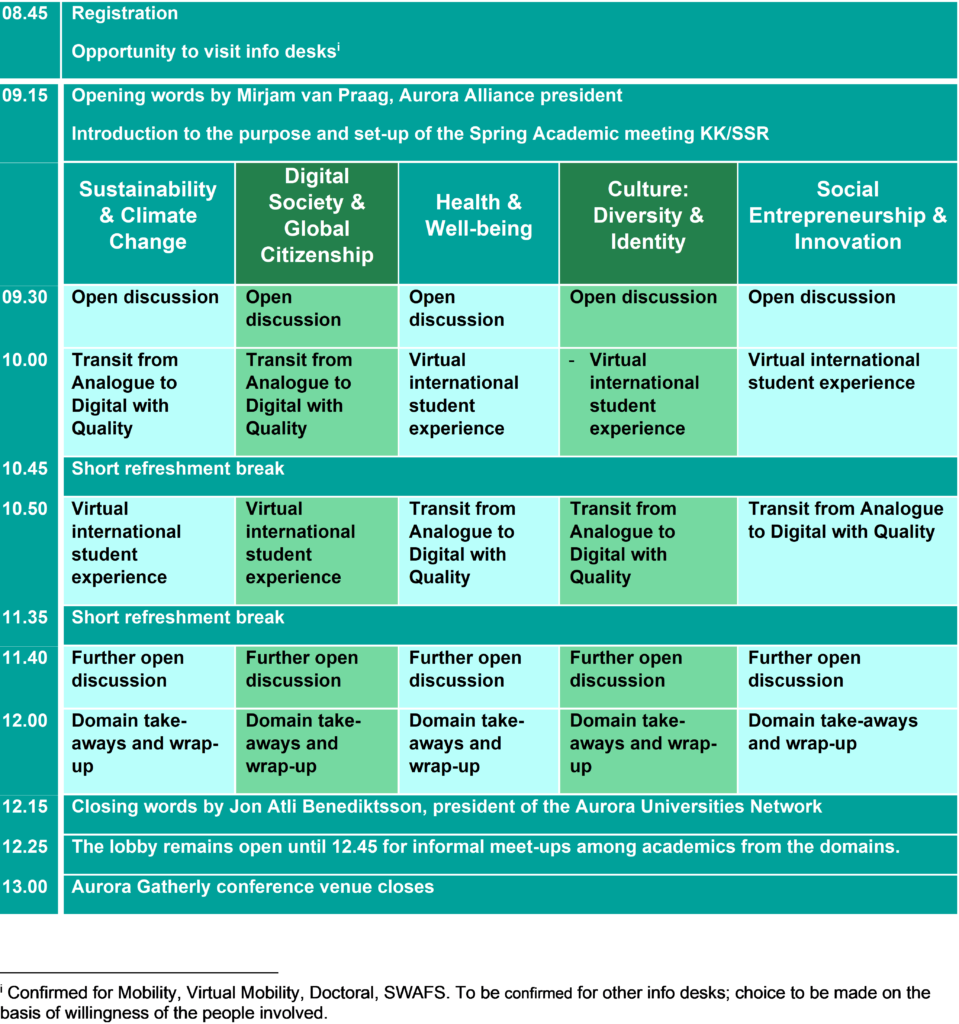
With continued international dimensions with less physical mobility, there will be specific attention on tools and platforms for virtual mobility and online joint courses. Please take a look at the table below for the full proposed schedule:

Spring Academic Meeting Programme
Proposed Programme

The Aurora Spring Academic event will be hosted on the Gatherly platform, which allows you to freely move and chat with participants in groups of two’s or three’s or more.

Info-desks

Before and after the sessions, you may visit info desks on the various tools and platforms developed in the Aurora European University Alliance programme; see below under the programme description.

You can stop by the info desks of your interest and get in touch with the colleagues involved.

Take-aways

So what can you expect as takeaways from this event?

  1. Meet, discuss and arrange follow-up contact with peers on your issues and concerns in the transit from analogue to high-quality digital education and/or students’ international opportunities
  2. Find out about existing good practices in high-quality digital education and virtual international experience
  3. Learn about useful Aurora tools and platforms for these challenges and meet the experts who can help you use them.

To register for the Aurora Spring Academic Meeting, please sign up here

Follow this page for more updates on the event. A pdf containing the full program for the event can be found using the following link: Aurora Spring Academic Meeting – Moving from Analogue to Digital with Quality- How Do We Do That


Aurora Alliance Newsletter #01

The Aurora Alliance has released its first newsletter at the beginning of 2021. Take a look at the newsletter for a comprehensive update on the latest developments in the Aurora Alliance, discussing for example what is happening in Aurora, the Aurora Pilot Domains, and upcoming events across the Alliance.

Next to that, the newsletter contains interesting blogs, columns, and profiles, created by the active and engaged Aurora Community.

You can read the newsletter here.

Want to stay updated, and be among the first to read about the latest Aurora developments? Why not subscribe to the newsletter!